MLSsoccer's Jonah Freedman hops back to his old SI.com stomping grounds to produce a Fortunate 50 piece on the highest-paid American athletes.
Want to know where soccer players rank?
Not a single one made the list.
Something for those raising freakishly athletically talented kids to keep in mind, perhaps.
Showing posts with label youth. Show all posts
Showing posts with label youth. Show all posts
Saturday, June 18, 2011


Thursday, October 16, 2008
Monday, October 13, 2008
Reading + Soccer = READ Futbol Mundial
It's not often that I get to combine my enthusiasm and experience in both soccer and education, but as guest editor for READ Futbol Mundial, that's exactly what I was able to do.
I've contributed articles to Futbol Mundial before, but the READ version is a different magazine aimed at engaging middle school students to read more by using soccer as a lure. The articles are trying to present positive role models and be instructive on different levels, teaching not only reading and writing skills, but a little financial literacy as well.
I was honored to be asked to participate in the project of putting together their second issue. I wrote quite a few of the articles in the magazine (Luis contributed one, too). The READ Futbol team put together an essay contest for kids as well, with "My Favorite Player" as a topic.
This issue is being distributed in the New York area, but all of the articles are available on the website and anyone in the country can enter the reading or essay contest. There's an option to upload photos. The issue has articles on the Olympics, a Claudio Suarez book review, an interview with Juan Pablo Angel, and more.
I've always respected the views of our readers, so if you have any suggestions and comments, post them here or on the READ Futbol Mundial site.
I've contributed articles to Futbol Mundial before, but the READ version is a different magazine aimed at engaging middle school students to read more by using soccer as a lure. The articles are trying to present positive role models and be instructive on different levels, teaching not only reading and writing skills, but a little financial literacy as well.
I was honored to be asked to participate in the project of putting together their second issue. I wrote quite a few of the articles in the magazine (Luis contributed one, too). The READ Futbol team put together an essay contest for kids as well, with "My Favorite Player" as a topic.
This issue is being distributed in the New York area, but all of the articles are available on the website and anyone in the country can enter the reading or essay contest. There's an option to upload photos. The issue has articles on the Olympics, a Claudio Suarez book review, an interview with Juan Pablo Angel, and more.
I've always respected the views of our readers, so if you have any suggestions and comments, post them here or on the READ Futbol Mundial site.
Saturday, September 20, 2008
Remember AYSO
Ah, the joys of AYSO!
Many people in the U.S., including Cobi Jones, first kicked a soccer ball around in AYSO. Besides introducing kids to the joys of soccer, the organization also supports projects to make the world a better place. They're working on a new venture with Barsa these days.
An AYSO worker explained: AYSO is working with FC Barcelona on a Malaria No More campaign. Basically what we are doing is asking anyone who plays youth sports (specifically soccer) to find family members, friends, etc to donate $1 for each game they play in order to raise money to buy bed nets. There are some pretty cool prizes as well. The website is www.morethanaclub.org.
Many people in the U.S., including Cobi Jones, first kicked a soccer ball around in AYSO. Besides introducing kids to the joys of soccer, the organization also supports projects to make the world a better place. They're working on a new venture with Barsa these days.
An AYSO worker explained: AYSO is working with FC Barcelona on a Malaria No More campaign. Basically what we are doing is asking anyone who plays youth sports (specifically soccer) to find family members, friends, etc to donate $1 for each game they play in order to raise money to buy bed nets. There are some pretty cool prizes as well. The website is www.morethanaclub.org.
Sunday, September 14, 2008
Who's got next?
Justin Rodriguez profiles Charles Renken. I actually think Charles will have an easier time of it because Freddy Adu came before him. People will be more careful about the hype they put on Charles. Freddy has lived up to many expectations with a pretty solid pro and international career, actually, but the build-up around him was such that some people still think he's disappointed.
Back when I first wrote about Charles, there was another young player on the U.S. youth scene garnering attention.
Though older than Charles, Sebastian Lletget was still a technical prodigy, and he and Charles intuitively recognized each other's skill and worked particularly well together. Sebastian was eligible for Italian citizenship (though that's notoriously difficult to get) and later completed a transfer to West Ham's youth system for a short stint.
But now he's not apparently there any more. He's not back in the U.S. youth system either. He's apparently in San Francisco (he participated in the adidas ESP camp in July of this year).
Back when I first wrote about Charles, there was another young player on the U.S. youth scene garnering attention.
Though older than Charles, Sebastian Lletget was still a technical prodigy, and he and Charles intuitively recognized each other's skill and worked particularly well together. Sebastian was eligible for Italian citizenship (though that's notoriously difficult to get) and later completed a transfer to West Ham's youth system for a short stint.
But now he's not apparently there any more. He's not back in the U.S. youth system either. He's apparently in San Francisco (he participated in the adidas ESP camp in July of this year).
Sunday, August 31, 2008
Pay to play
Paying for field access has become part of the price of the beautiful game for some.
On the one hand, it's a great thing that soccer fields are in such high demand.
On the other hand, things shouldn't get to the point where people are gouged to use a field.
On the one hand, it's a great thing that soccer fields are in such high demand.
On the other hand, things shouldn't get to the point where people are gouged to use a field.
Wednesday, August 27, 2008
Developing talent
About a year ago, I talked to Brad Friedel about his plans for a youth academy in Ohio. It was actually still in the process of being built and planned and such. I believe it's in its just completed its first full year or it's been opened right around there. Things seem to be heading in the right direction for Premier Soccer Academies.
The PSA just had two of its year-round members invited to Bradenton for the full-time residency program there - Victor Garza of Edinburg, Texas and Joel Nash of Birmingham, Ala.
I know Friedel sounded enthusiastic about the project when talking about it and how the entire youth system in the United States was ass backwards. He said something to the effect that kids train once a week and play a bunch of games on the weekend and he said it should be multiple training sessions a week and one game on the weekend. He also said many youth coaches were just in it for the money. It was a really good interview and he seemed very passionate about it.
Anyway, here's what he said in a press release about Garza and Nash and the US national team.
“It is a tremendous honor to have any of our players be selected for their current national team,” said Brad Friedel, President and Co-Founder of PSA. “We are delighted to have Joel and Victor further their career playing for their country. It is our goal at PSA to give every player the opportunity to reach their goals and this is a prime example as these two players move to the next level.”
And this is the description of the PSA from the same press release
PSA is the first residential soccer academy of its kind offering full year-round scholarships to athletes in an effort to develop the next generation of professional soccer players. Each year players from across the globe, ages 12-17, will be recruited based on ability and skill level, not the parents’ ability to pay. Additional athletic, academic, and health/nutrition programs along with an assortment of different level coaching clinics, will be offered throughout the year targeting all ages and skill levels. Facilities are state-of-the-art and include three and a half soccer fields, indoor fieldhouse, 5,000-square-foot workout facility, student housing and academic learning center. PSA officially opened August 20, 2007 with the arrival of the first class of residency members.
MLS' development system is nowhere near as developed as Brad Friedel's which is a shame because they've got a 12-year head start on him. And even if teams do develop young talent there are so many loopholes and restrictions and stuff that they could miss players anyway.
Perhaps it will take Friedel and others like him to get a true youth development system in place in the US so we can start seeing youngsters develop like they should right here in the US.
The PSA just had two of its year-round members invited to Bradenton for the full-time residency program there - Victor Garza of Edinburg, Texas and Joel Nash of Birmingham, Ala.
I know Friedel sounded enthusiastic about the project when talking about it and how the entire youth system in the United States was ass backwards. He said something to the effect that kids train once a week and play a bunch of games on the weekend and he said it should be multiple training sessions a week and one game on the weekend. He also said many youth coaches were just in it for the money. It was a really good interview and he seemed very passionate about it.
Anyway, here's what he said in a press release about Garza and Nash and the US national team.
“It is a tremendous honor to have any of our players be selected for their current national team,” said Brad Friedel, President and Co-Founder of PSA. “We are delighted to have Joel and Victor further their career playing for their country. It is our goal at PSA to give every player the opportunity to reach their goals and this is a prime example as these two players move to the next level.”
And this is the description of the PSA from the same press release
PSA is the first residential soccer academy of its kind offering full year-round scholarships to athletes in an effort to develop the next generation of professional soccer players. Each year players from across the globe, ages 12-17, will be recruited based on ability and skill level, not the parents’ ability to pay. Additional athletic, academic, and health/nutrition programs along with an assortment of different level coaching clinics, will be offered throughout the year targeting all ages and skill levels. Facilities are state-of-the-art and include three and a half soccer fields, indoor fieldhouse, 5,000-square-foot workout facility, student housing and academic learning center. PSA officially opened August 20, 2007 with the arrival of the first class of residency members.
MLS' development system is nowhere near as developed as Brad Friedel's which is a shame because they've got a 12-year head start on him. And even if teams do develop young talent there are so many loopholes and restrictions and stuff that they could miss players anyway.
Perhaps it will take Friedel and others like him to get a true youth development system in place in the US so we can start seeing youngsters develop like they should right here in the US.
Monday, August 25, 2008
Saturday, August 23, 2008
Out of the gym, onto the field
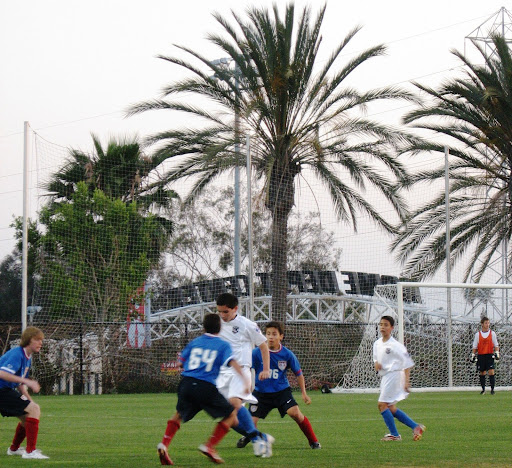
Someone pointed out to me the moment he knew the U.S. was going to defeat Brazil for the gold medal.
It was during the break for the overtime periods, when Brazil's players fell to the ground to rest, exhausted. The U.S. players were obviously fitter, and a tired Brazilian defense would probably give up chances.
When I was watching Argentina versus Nigeria, I had a similar epiphany when the referee stopped play for a water break. Argentina had looked plodding, but as their players hydrated and received encouragement and instruction from their coach, I thought, "This break will save them. They get the water they need, they catch their breath against the athletic Nigerians, they get that little second wind they need to create something."
There's always that push-pull between athleticism and artistry. In the U.S., we're so competitive as a country that we push kids into formal soccer games as young as four. They're lugging around little trophies.
Though they're not on the exact same topic, I found these points of view interesting. The first is from an article on the Argentine team, which quotes their coach, Batista.
"In Argentina we are making some mistakes," he told me. "We are emulating things that take us further away from our football. And we are depriving children of their childhood. There is too much emphasis on work in the gym, on weight-training and speed. And too much pressure on kids as young as seven or eight to win. This is not good."
"The child is not treated as a child," Batista argues. "I believe strongly in respecting the stages - there is a time when you have to play for fun, enjoy the game. Argentina's strong point has always been technique. If you look at the best players in Europe, they are always the ones who are technically excellent. Gyms and machines can never give you what keepy-uppies and contact with the ball do for a child."
The other viewpoint arrived in my email inbox from a reader. If other readers have any thoughts on the merits of fitness and strength versus technique and the best balance, or if anyone wants to tackle the question this reader posits, post in the comments.
I just wanted to say that your article a few months back on college soccer hurting the development of our young players should be on the front of soccernet and required reading for everyone high up in the USSF and MLS. We have more and more people playing the game as soccer grows more popular, but we still will still have a serious lack of quality players unless our youth player development system is completely overhauled. We can't insist on following the high school-college-draft model we use for basketball and football. Soccer is a completely different game that relies much less on size and athleticism (which can be developed anywhere) than the other two.
We need to look towards Europe and Latin America for how to develop soccer players. They've been playing the sport longer than we've played anything, and they have it figured out. If we have any desires of turning into a powerful soccer nation we need to adopt the same system of youth teams owned by the professional clubs. There are innumerable problems with our current model, as I'm sure you're familiar with, so I'll just stick to the most obvious.
The first and most important is that the current model has our talent far too spread out over the country. There are thousands of high school soccer teams in America, so none of our young players are exposed to a really high level of competition. In other countries, it's centralized, so you have the top youth division, with 20 teams, followed by the next, followed by the next. Thus the best young players week in and week out get exposed to the highest level of competition and the best coaching available in the country. If a player isn't good enough, he's cut and a better one takes his place, so this elite level of play is maintained, and obviosuly every young player's dream is to be a part of these leagues. It is the most nurturing environment possible to create good soccer players. In the United States, we may have 12 year olds with the potential to be the next Zidane, but unlike their European and Latin American counterparts they will spend the ages of 12-22 unexposed to a high level play, not to mention very, very poorly coached (relatively speaking, let's face it, in the older generations soccer was much less popular, thus we have a smaller pool) by coaches who have the wrong objectives, which brings me to my next point.
The coaches of high school and college teams in the United States have one thing in mind: winning. That is how their success is measured and their only incentive. Youth teams in the rest of their world have one objective, and that is churning out top quality players for the parent club. The end product is not only technichally superior but far more creative and tactically aware than American soccer players, who may be just as athletic. No one cares if the youth team wins or loses, as long as it yields great players for the club. But in the US the youth teams only focus on winning, thus our prodigies spend their practices focusing on conditioning and learning how to play the American youth soccer game, aka running war. How on earth we decide our youth game to allow unlimited substitutions, I have no idea. It's barely soccer at that point.
There is also the issue of scouting, how do we expect ourselves to find talent (which evaluating is much more subjective than basketball and football, it's not just a matter of who's bigger and faster and who gets the best stats) when there are thousands of high schools spread out over this vast nation, and then come age 18 all of the players move to completely different systems? And I'm not even getting into how bad the youth programs in this country are, the profiteering, the poor coaching, etc. etc.
Though our current system may be decent for developing mid level talent, ie lots of pretty good high school soccer players, I am amazed that despite having to grow up playing their game in America we still have some decent players that can make mid level European leagues. But if the MLS is to survive (with it's rapid expansion, the talent pool is going to be spread very thin, and since the last draft was very weak, as well as the one before it with the exception of Edu, I fear things are only going to get worse) and if we are to have any real success on the international level, we need to adopt the European system as soon as possible.
It'll take a long time for the changes to come into effect as developing a good youth system takes years, not to mention it'll take 7 or 8 years before we have our first young ones who have made it all the way through the system. There need to be major incentives for MLS teams to create these systems, as well as funding from the MLS. Each MLS team needs to have sole access to the contract rights of its youth players (they cannot go to the draft, then there'd be no incentive), and I think players from a team's youth system, at least at the beginning, should have a portion of their salary not count toward's the team's salary cap. The youth teams need to get the best facilities and coaches and need to be exposed to the best competition. We need all of our young soccer players striving to play these teams so that our very best are all put together in the most nurturing environment possible.
Am I the only one that thinks this way? Is there any chance of the European system becoming the norm here? What can the average frustrated American soccer fan do to help bring about change?
Thursday, July 31, 2008
They're coming for the kids
Part of me is really skeptical about teams abroad tapping into the U.S. youth soccer market.
I mean, unless they naturalize a bunch of players, they can't bring over American prospects who don't meet work permit standards. It's all well and good to want to play in Europe, but generally, you have to do something here first before they want you over there.
I mean, unless they naturalize a bunch of players, they can't bring over American prospects who don't meet work permit standards. It's all well and good to want to play in Europe, but generally, you have to do something here first before they want you over there.
Friday, April 11, 2008
Talent is out there
The United States has countless numbers of unearthed gems that will never get discovered. Some go unnoticed because of financial situations, others get passed over because they don't fit the mold. Whatever the case, players are slipping through the cracks - the only question is how many of them are doing so.
Here's a good story from Culture of Soccer of a brother and sister pair born and raised in the farming communities of central California who are getting their shot for Mexico, Amber and Alexis Hernandez.
The US may still reap the rewards from the Alexis, as he has apparently been contacted by US Soccer.
Here's a good story from Culture of Soccer of a brother and sister pair born and raised in the farming communities of central California who are getting their shot for Mexico, Amber and Alexis Hernandez.
The US may still reap the rewards from the Alexis, as he has apparently been contacted by US Soccer.
Monday, July 16, 2007


Sunday, July 15, 2007
Nice day for soccer
This morning I was covering the Adidas ESP girls' camp for TopDrawerSoccer. There will be a story up on that site later, but for now, here's a few pictures of some of the top young players in the championship game during camp.
 Sending in a pass
 The goalkeeper claimed this attempt.
 Defending a corner kick
 Sending in a pass
 The goalkeeper claimed this attempt.
  Defending a corner kick
Thursday, July 12, 2007
Gatorade POY pics
More pictures from the Gatorade event. Sorry they're so dark - my camera is pretty puny.

Kevin Love was the male winner. The basketball star is going to play locally, for the UCLA Bruins.
 Maya Moore, flanked here by Lisa Leslie and Chris Paul, gestures during her thank-you speech, which was a nice tribute to her supportive family. She's going to women's college basketball powerhouse Connecticut.
Vince Carter looks like he's ready to clobber Stuart Scott with that award if Stu cracks a joke at his expense. In the background lurks Greg Oden, who has Vince's back in case Stu causes any difficulty.
Martinez on mentality


I don't want to excuse the Uruguayan players who reacted the way they did after losing to the U.S. - I saw part of what the video showed one in particular did to Michael Bradley. Frankly, I also believe it's possible to care passionately about winning and be extremely competitive without losing the sportsmanship that makes soccer special. Yes, it may seem strange to exchange a sweaty jersey, but I think it's a great memento and tradition. When Poland got spanked by the U.S., I thought it was really classy of them to ask for the U.S. players jerseys afterwards. That was nice to see. They could have sulked off, but they didn't. Anyway, when I talked to Bryan Martinez at the Gatorade National Athlete of the Year event (the article is filed with espn.com, but it's in limbo while a bunch of Beckham arrival stuff gets priority), the game between Uruguay and the U.S. hadn't yet been played. Brayan played with a couple of the Uruguayan players, specifically one from Salto, the same city where Brayan lived until he moved to the States at 13.
"I have friends that are playing on the Uruguayan youth national team and playing professionally as well," said Brayan. "I look back on that and think about how that could have been me."
It was Uruguay's dangerous forward who Brayan knew well.
"The biggest reason I stayed was for my family, because my parents asked me to. I think if I never lived with them, I’d have lost a great opportunity to get close to them and to my sister. I know that my grandparents cared for me all my life and I love them for that, but I wanted to experience life with my parents as well."
I think Brayan was really able to enjoy the day, because I don't think he was worried he'd win the big prize. "I’m just happy to be here. I met new people and I’m glad for the experience. I love LA." It was enough, he said, to be with an unexpected special announcement some timeback that he'd won the soccer award and was in the running for the national one."It was a surprise. They told me to come in for something else and when I got there, everyone was waiting to celebrate and they told me. I didn’t expect anything. It was a great moment for me, especially seeing my dad there. He’s working a lot, so he doesn’t get to see many games. So to have my family there for the honor was great. I never thought I even had a chance, because it’s a big country and there are so many soccer players here. It’s a great honor. "
It 's not like the game he left behind in Uruguay, though, which he still misses.
"It was hard to leave the football there behind," Brayan.
Monday, May 28, 2007
Amazing Gracie
I've already told my story about playing on a boys' team. I don't want to make it seem that dramatic, though, because honestly, it happened partly because I went to a very small school.
Though I never had huge aspirations to play at a high level, I quit soccer varsity during my sophomore year of high school. I was out of all sports for a good while because I'd suffered a back injury. It didn't happen while playing soccer, but for a long time, it would swell up if I tried to play again.
Anyway, the story of Gracie is actually based on Elizabeth Shue's own experience. According to an LA Times feature on Shue, though, her story didn't have such a happy ending. She quit the game partly due to the pressure and lack of support for a girl competing side-by-side alongside boys.
Thanks to the magic of the movies, however, Gracie gets the happy ending.
For Galaxy fans, alum Andrew Shue also has a role in the film.
Some coaches, even ones for the national team system, question the dedication of females to the game.
"Most of them don't play after 22," said one. "They haven't cultivated a real love for the sport."
While I agree that some players get pushed so hard that they burn out, I don't think it's coincidental that there's really no place for good female players to go at 22, except for rec soccer.
Though I never had huge aspirations to play at a high level, I quit soccer varsity during my sophomore year of high school. I was out of all sports for a good while because I'd suffered a back injury. It didn't happen while playing soccer, but for a long time, it would swell up if I tried to play again.
Anyway, the story of Gracie is actually based on Elizabeth Shue's own experience. According to an LA Times feature on Shue, though, her story didn't have such a happy ending. She quit the game partly due to the pressure and lack of support for a girl competing side-by-side alongside boys.
Thanks to the magic of the movies, however, Gracie gets the happy ending.
For Galaxy fans, alum Andrew Shue also has a role in the film.
Some coaches, even ones for the national team system, question the dedication of females to the game.
"Most of them don't play after 22," said one. "They haven't cultivated a real love for the sport."
While I agree that some players get pushed so hard that they burn out, I don't think it's coincidental that there's really no place for good female players to go at 22, except for rec soccer.
Wednesday, May 23, 2007
Going after the girls
At the U15 match versus the SoCal Blues, a coach from USC stopped by.
A couple of the Blues speculated that he was there to recruit.
"They're going to start talking to thirteen year-olds next," one said.
A couple of the Blues speculated that he was there to recruit.
"They're going to start talking to thirteen year-olds next," one said.
Saturday, May 19, 2007
Kids today
The last games of the U14 boys national team camp.
Coach Manny offered some interesting thoughts on what young soccer players need most to develop.
Coach Manny offered some interesting thoughts on what young soccer players need most to develop.
Saturday, March 17, 2007
Troubled waters
 The Galaxy Rios youth program looks to have run into something of an extortion threat from Coast Soccer League, at least according to one of their bigwigs, Gary Sparks.
I'm thinking that perhaps the year that David Beckham arrives isn't the best time to threaten to cut ties with the Galaxy, but what do I know? I'm not a fan of youth soccer politics, though I admire the many good people involved on that level.
Mike Woitalla's orginal article takes a more general look at the MLS youth programs.
I really wish Gary Sparks had called me back. I wanted to ask him why he wasn't giving Chivas USA, another LA-based MLS team, the same conditions as the ones he was putting on the Galaxy. Maybe that's actually part of the threat - Sparks could be implying that everyone in the CSL will become Chivas USA fans if the Galaxy don't accept his offer.
It just seems very godfatherish, the whole idea - I don't see Frank or Alexi going for it.
Subscribe to:
Posts (Atom)